QLIF#
Introduction#
The Quadratic Integrate-and-Fire (QLIF) neuron model is a simple yet effective spiking neuron model that is widely used in computational neuroscience. The QLIF model is an extension of the LIF model, where the quadratic term in the membrane potential is taken into account to capture the subthreshold nonlinearity. This allows for more accurate modeling of spiking behavior and adaptation in biological neurons. In this model, the membrane potential of a neuron evolves linearly in time in the subthreshold regime and is reset to a fixed value after a spike.
How does it work?#
The quadratic integrate-and-fire (QLIF) neuron model is a variation of the LIF model that takes into account the fact that the firing rate of a neuron may depend on the input current in a nonlinear way. The QLIF neuron model assumes that the firing rate of the neuron is proportional to the square root of the membrane potential difference between the threshold potential and the resting potential, rather than being simply proportional to this difference, as in the LIF model.
The QLIF model has a quadratic term in the membrane equation that makes it nonlinear, and it allows for a more accurate description of spiking behavior in some biological neurons. The membrane equation of the QLIF neuron model can be written as:
$$ \begin{align*} \ &\tau_m\frac{du}{dt}\ = a_0(u(t) - u_{rest}) (u(t) - u_{critical}) + RI(t) &\text{if }\quad u(t) \leq u_{th}\ \end{align*} $$
$$ \begin{align*} &u(t) = u_{rest} &\text{otherwise}\ \ \end{align*} $$
To simulate the QLIF neuron model, we can use a similar approach to the LIF model. We solve the membrane equation using the forward Euler method, but we modify the update rule to include the nonlinear quadratic term. For small enough time steps, this approach provides a good approximation of the continuous-time integration of the membrane potential.
Strengths:#
Weaknesses:#
Usage#
QLIF Population model can be used by given code:
from synapticflow.network import neural_populations
model = neural_populations.QLIFPopulation(n=10)
Then you can stimulate each time step by calling forward function:
model.forward(torch.tensor([10 for _ in range(model.n)]))
All available attributes like spike trace and membrane potential is available by model instance:
print(model.s) # Model spike trace
print(model.v) # Model membrane potential
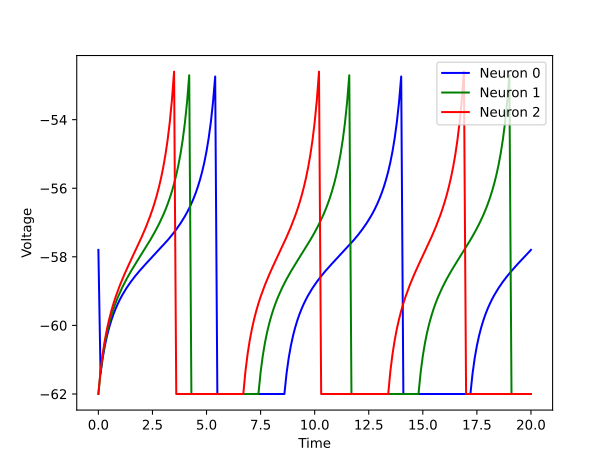
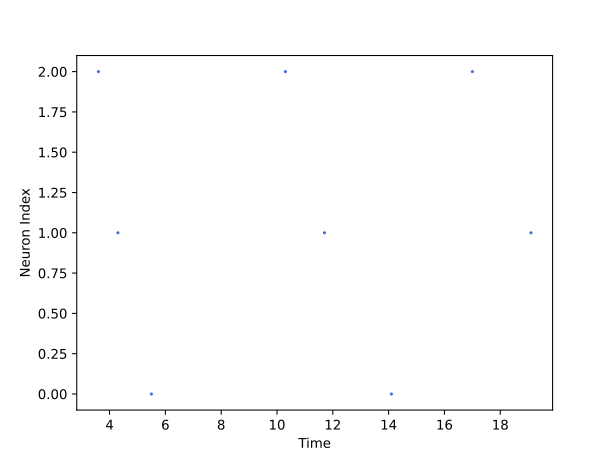
And in the same way, you can use the visualization file to draw plots of the obtained answer:
Parameters:#
n (int, optional) - Number of neurons in this layer.
shape (Iterable[int], optional) - Shape of the input tensor to the layer.
spike_trace (bool, optional) - Indicates whether to use synaptic traces or not.
additive_spike_trace (bool, optional) - If true, uses additive spike traces instead of multiplicative ones.
tau_s (float or torch.Tensor, optional) - Decay time constant for spike trace. Default : 10
a0 (Union[float, torch.Tensor], optional) - A float or tensor representing initial quadratic parameter value.
critical_pot (Union[float, torch.Tensor], optional) - A float or tensor representing the critical potential value for quadratic parameter.
threshold (float or torch.Tensor, optional) - The spike threshold of the neuron.
rest_pot (float or torch.Tensor, optional) - The resting potential of the neuron.
reset_pot (float or torch.Tensor, optional) - The reset potential of the neuron.
refrac_length (float or torch.Tensor, optional) - The refractory period length of the neuron in timesteps.
dt (float, optional) - The time step length.
lower_bound (float, optional) - Minimum value for the membrane potential of the neuron.
sum_input (bool, optional) - If true, sums input instead of averaging it.
trace_scale (float, optional) - Scaling factor for the synaptic traces.
is_inhibitory (bool, optional) - Indicates whether the neuron is inhibitory or not.
R (Union[float, torch.Tensor], optional) - The time constant of the neuron voltage decay.
learning (bool, optional) - Indicates whether the neuron should update its weights during training.